
The Creative Technologist Roundup x 10.0

🌟 Get ready, creative tech trailblazers! 🚀 This week’s Creative Tech Roundup is all about groundbreaking shifts in AI and digital creativity that’ll have your brain firing on all cylinders! 🤖💥 From Salesforce’s nautical AI adventure 🌊 and Runway’s animation revolution 🎬, to MLS’s new NFT playground ⚽️ and Microsoft’s ‘AI employees’ taking over the digital workspace 💼🤯, there’s a tech innovation for everyone! 🎉 Dive in to discover how Google and Jacob Collier are reimagining music-making 🎶, and how IBM’s open-source Granite 3.0 is setting new standards for enterprise AI! 📈💡 Grab your creative toolkit, and let’s dive into the future! 🌐✨
Activations
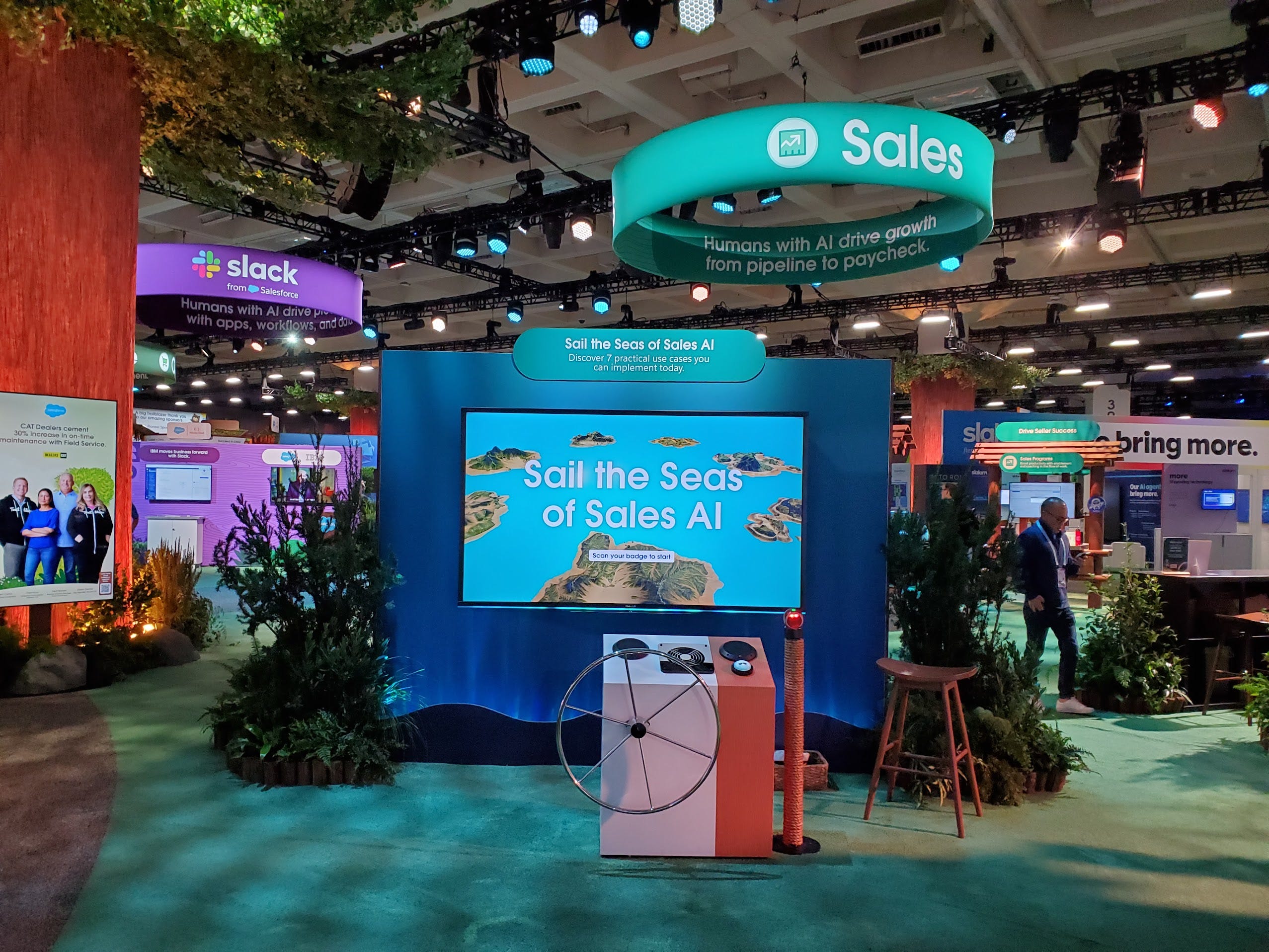
Salesforce Dreamforce 24 - Sail the Seas of Sales AI
The "Sail the Seas of Sales AI" activation is an innovative experience, expertly crafted by the team at GPJ in just six weeks, to immerse sales professionals in the world of Salesforce’s AI tools. The concept combines a nautical journey with interactive learning, allowing attendees to explore the potential of AI in sales in a highly engaging and visually captivating way.
Here’s what makes it stand out:
Nautical Theme, GPJ Precision: With only six weeks to bring this vision to life, GPJ executed a full-scale, maritime-inspired setup, complete with a ship’s wheel, island visuals, and vibrant greenery. Each island represents a different AI solution, creating a seamless, gamified journey through Sales Cloud’s capabilities.
Seven Key AI Tools: Attendees navigate through islands that showcase specific AI features, like Call Support and Predictive Selling, offering a comprehensive look at Salesforce’s AI-driven innovations in sales.
Personalized Interactive Experience: Rather than a standard demo, this setup puts attendees in control of their journey. By steering the ship to islands of their choice, participants can explore at their own pace, discovering the tools that resonate most with their needs.
Targeted for Sales Professionals: Designed with sales reps and leaders in mind, the experience illustrates the practical, real-world benefits of AI, blending entertainment with meaningful insights.
Overall, GPJ’s "Sail the Seas of Sales AI" is an impressive blend of creativity and efficiency, transforming AI learning into an immersive adventure. It’s a standout example of how innovative design can enhance understanding of complex tools in a short timeframe.
Bytes
#TechNews

#Content
Runway Research | Introducing Act-One
Runway has introduced Act-One, a new tool designed to generate expressive character animations from simple video inputs, released within their Gen-3 Alpha platform. Act-One allows creators to transform an actor’s performance, captured with minimal equipment, into digital characters, preserving intricate details like eye-lines, micro-expressions, and pacing. Unlike traditional animation methods that rely on complex motion capture setups and manual face rigging, Act-One uses video and voice as direct inputs, making it accessible for a wide range of creators. Its versatility extends to generating characters with proportions differing from the original actor, making it suitable for various creative projects, from live-action to animated content. Runway has also emphasized content safety, implementing measures to prevent misuse, including protections around public figure content and user rights verification.

#AI
Anthropic publicly releases AI tool that can take over the user’s mouse cursor
Anthropic has publicly released "Computer Use," a new feature within its Claude 3.5 model that allows the AI to control a user's mouse cursor to perform tasks on their computer. Available via API with the mid-range Sonnet model, this tool enables multi-step actions based on visual cues from screenshots, allowing Claude to "see" the screen, move the cursor, click buttons, and type text. While it has limitations, such as difficulties with drag-and-drop actions and potential errors when processing rapid screen changes, Computer Use has been tested by companies like Amazon, Canva, Asana, and Notion. Anthropic emphasizes safeguards to prevent misuse, particularly with concerns around election integrity. The release marks a significant development in AI-driven automation, with potential applications for streamlining repetitive tasks in office settings and quality assurance, though it raises ongoing debates about automation’s impact on jobs.

#Sports
MLS launching NFT-based game platform with Sweet
NFT platform Sweet has announced MLS Quest, a blockchain-based collectibles marketplace and gaming platform developed in partnership with Major League Soccer (MLS) and the MLS Players Association. MLS Quest allows fans to collect NFTs in the form of virtual medallions featuring highlights from MLS matches, which can be redeemed for real-world rewards or traded with others. This initiative marks Sweet's second major sports league collaboration after launching the NHL Breakaway platform. Unlike previous NFT initiatives, which focused heavily on monetization, MLS Quest emphasizes gameplay and fan engagement, allowing users to start for free by collecting medallions via QR codes available at games, on broadcasts, and online. Revenue streams for MLS Quest will eventually include medallion pack sales, peer-to-peer royalties, and a premium subscription, although initial focus is on user experience rather than direct sales.
4o

#Music
How Jacob Collier helped shape the new MusicFX DJ
Google Labs has collaborated with Grammy-winning musician Jacob Collier to enhance MusicFX DJ, a generative music tool that enables users to create continuous, customizable music flows. Over the past year, Collier worked with Google DeepMind and Google Labs, contributing his creative insights to develop intuitive controls and an updated interface that allows users to shape music in real-time by adjusting aspects like tempo, brightness, and mood. The new features aim to make musical creation accessible for all skill levels, helping users enter a flow state of creativity. Additionally, users can now share 60-second segments of their MusicFX DJ sessions, allowing others to remix and build upon the original creation. This collaboration highlights Google Labs' commitment to co-creating technology with artists and creatives, pushing the boundaries of AI-driven artistic tools.

#Agents
Microsoft introduces ‘AI employees’ that can handle client queries
Microsoft has introduced "AI employees"—autonomous virtual agents capable of handling tasks like client queries and sales lead identification—as part of its Copilot Studio product, which allows customers to create customized AI agents without coding skills. Additionally, Microsoft is releasing 10 pre-built AI agents suited for roles such as supply chain management and customer service. Early adopters, including McKinsey, Clifford Chance, and Pets at Home, are using the technology to streamline operations and improve productivity by automating routine tasks. Microsoft CEO Satya Nadella emphasized that these agents aim to reduce "drudgery" and increase efficiency, likening the AI shift to the advent of personal computers. Powered by Microsoft’s and OpenAI's models, the agents also demonstrate potential for performing transactions autonomously, though this capability is still under development. While some experts view AI agents as a potential path to economic returns on AI investments, others caution that fully human-like capabilities are yet to be achieved.

#OpenSource
IBM debuts open source Granite 3.0 LLMs for enterprise AI
IBM has launched Granite 3.0, a suite of open-source large language models (LLMs) for enterprise AI, designed for use cases such as customer service, IT automation, and cybersecurity. Available through IBM’s watsonX, Amazon Bedrock, Amazon Sagemaker, and Hugging Face, Granite 3.0 models include general-purpose and specialized "Guardian" versions focused on safety and reliability. These models are open-source, licensed under Apache 2.0, which allows partners to build proprietary applications, distinguishing IBM’s models from other open AI models that lack OSI-approved licensing. IBM’s models were trained on 12 trillion tokens of diverse data, contributing to high-performance benchmarks and secure deployment. Senior IBM leaders noted that this approach to open-source AI, combined with the concept of "generative computing," aims to redefine how enterprises adopt and scale AI by allowing users to interact with AI models through examples rather than traditional coding.
Bits
#CoolStuff
- The step-by-step playbook to hijack Spotify Wrapped 💿
- How we built AI search in Figma
- NVIDIA Computer Finds Largest Known Prime, Blows Past Record by 16 Million Digits
- Made in Figma: The National Park Service goes from paper to pixels
- 📱 Designing For Gen Z: Expectations and UX Guidelines
- Instagram’s latest feature is a digital business card for your profile
- Technology KICKBACK Is Bringing Back the 90s With Its Latest Modern-Retro Tech
- Arcade, a new AI product creation platform, designed this necklace